• You must be logged in to see or use the Shoutbox. Besides, if you haven't registered, you really should. It's quick and it will make your life a little better. Trust me. So just register and make yourself at home with like-minded individuals who share either your morbid curiousity or sense of gallows humor.

Sugar Cookie

Veteran Member
Bold Member!
1719553860891.webp

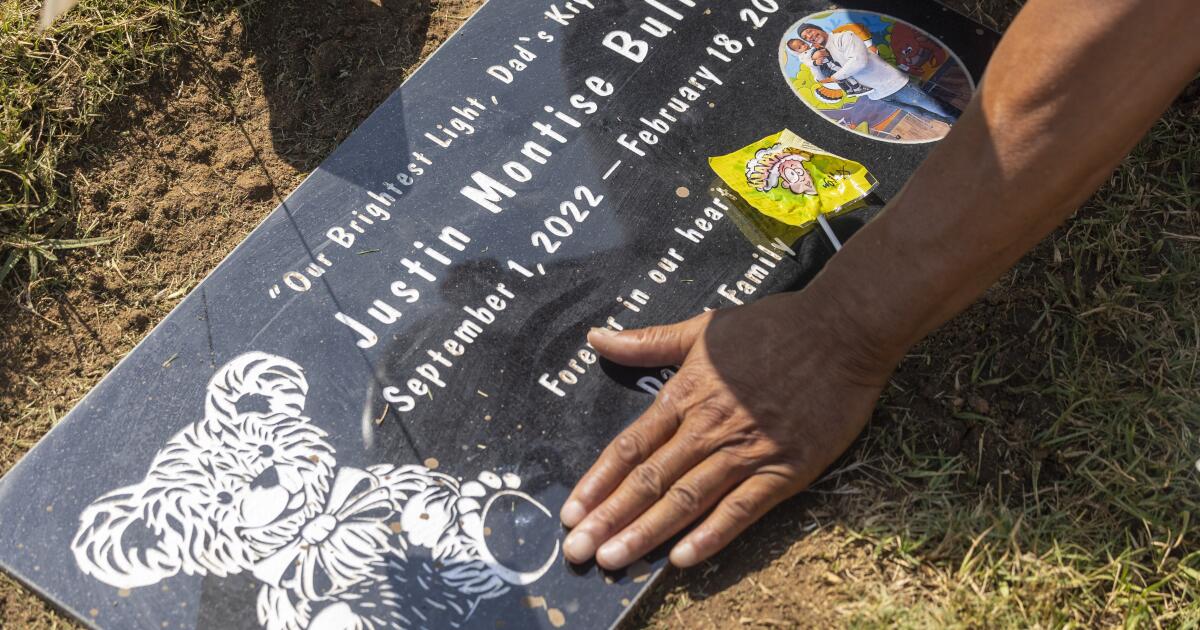
Justin Bulley had been in the custody of Los Angeles County's child welfare system, but during an approved visit with his mom, the toddler somehow came into contact with the county's most deadly drug.

Within hours, the 1-year-old was dead.

The cause: A lethal dose of fentanyl — the synthetic opioid 50 times more potent than heroin — was found in the toddler's bloodstream.
"They robbed me," said Montise Bulley, Justin's father. He and the toddler's mother were estranged, he said, but when she lost custody of Justin to the Los Angeles County's Department of Children and Family Services, so did he. At the time of the boy's death, he had been fighting to gain full custody of his son, he said.

Bulley, a truck driver, said at a news conference Wednesday he was still in shock over Justin's death in February.

"I just miss my boy," Bulley, 51, said. "I cry every day almost."
He blames the Department of Children and Family Services for failing to protect his son.
Brian Claypool, an attorney representing Bulley and two of Justin's siblings, filed a notice of claims this week with L.A. County for damages of $65 million, with an intent to file a wrongful-death lawsuit against the Department of Children and Family Services.

"How in the world did this happen?" Claypool said. "There's one answer: because we have a pathetic L.A. County Department of Children and Family Services in Lancaster. It's absolutely horrific."

Claypool called Justin's death the latest in a string of tragedies in which children in the Antelope Valley have died on the department's watch. Despite several tragic cases, which sparked investigations and leadership changes, Claypool said Justin's death shows that needed changes at the nation's largest child welfare system still have not occurred.

"What happened that day shouldn't have happened," Claypool said. "They toss underserved kids under the bus."

Claypool also represents the family members of Noah Cuatro, the Palmdale 4-year-old whose parents tortured and killed him in 2019, and 10-year-old Anthony Avalos, who died after enduring torture and prolonged abuse at his Lancaster home, despite many warnings to DCFS.

But the attorney called Justin's death "the worst case of malfeasance I've ever seen in my entire lifetime."

The Los Angeles County medical examiner found this month that Justin's Feb. 18 death was caused by the "effects of fentanyl," ruling it an accidental death. The toddler died at the Antelope Valley Medical Center in Lancaster, where he was taken after family found him unconscious at his mother's house and called 911, according to the autopsy report.

Paramedics who responded to the home attempted to use naloxone, the opioid overdose reversal drug, on the child, the report said.
According to the medical examiner's investigation, his mother told officials she had been drinking alcohol while Justin and his two siblings, ages 3 and 5, were visiting the home, and their grandfather had been smoking fentanyl. The report noted there were "several versions as to what occurred at the scene," but the grandfather told officials that the child had an "interaction with fentanyl at some point," the report said.
The autopsy found no other trauma. The toxicology report found Justin had 25 nanograms per milliliter in his blood. A Delaware medical examiner's report noted that just 4 nanograms per milliliter can cause an overdose death in an otherwise healthy person.

Deputies who later searched the home found "glass pipes, baggies with unknown substances and other drug paraphernalia," including some in "areas reachable by the children," according to the medical examiner's report.

No arrests have been made in Justin's death, but the Los Angeles County Sheriff's Department continues to investigate the case, according to Lt. Michael Gomez, who leads the agency's homicide division. Gomez said detectives were working with the district attorney's office to make a forthcoming determination on whether charges would be filed.
In Claypool's notice of damages, he alleged that a DCFS worker had been at the home supervising the visit the day of Justin's death but that the staffer fled the scene when the toddler was found unconscious. The document — filed with the county Board of Supervisors, a required first step before a civil suit — claims that Justin's siblings also had ingested fentanyl.

According to Lt. Gomez, the other children in the home at the time of Justin's death were tested for fentanyl by the DCFS, but he declined to share those results. He said he was unaware of a DCFS worker being at the home the day of Justin's death.
As Bulley spoke Wednesday about the forthcoming lawsuit, he held up a photo of himself with his son and kissed the image of the child's face.

"I don't care about the money, I want my son," Bulley said.

Claypool maintains that Justin and his siblings should not have been allowed to visit their mother, given her past, which includes convictions for drunk driving and child endangerment in 2023, according to court records. He also cited the grandfather's criminal history, which includes drug-related arrests.

"For years, the Los Angeles County Department of Children and Family Services was aware of the danger the children were in and allowed their mother and grandfather continued access," Claypool wrote in the damages notice.

"There were massive red flags in this case," Claypool said. "In this matter, DCFS played Russian roulette with the lives of Justin" and his siblings.

So it took dad three times nutting in this woman to figure out she was a useless junkie:confused:
 
Last edited:
Secret Daniel was supposed to keep the bubbly toddler safe.
As a monitor approved by the L.A. County Department of Children and Family Services, she was responsible for supervising the Feb. 18 visit between Justin Bulley, who was just starting to talk at 17 months, and his mother, who had struggled with substance abuse throughout his short life.
DCFS had placed Justin and his two older siblings with a foster mother the previous year, after his mother's boyfriend fatally overdosed on fentanyl with the kids at home.

Around 6:15 p.m., Justin's mother called 911. The toddler had stopped breathing.

“It was fentanyl,” Justin's grandfather told paramedics when they arrived at his Lancaster home, according to a sheriff's report.
By that point, Daniel had left the home.

Daniel was not a social worker but a friend of Justin's mother, Jessica Darthard. DCFS had approved her as a monitor, unaware that she was living in the Lancaster home with Justin's grandfather, Jessie, who had a long history of heavy drug use, according to a county source familiar with Justin's child welfare case who was not authorized to speak publicly.
Jessie Darthard, the grandfather, told sheriff’s deputies that he had fallen asleep on the couch while smoking fentanyl and awoke to Justin lying next to him, unresponsive.

Jessica Darthard, the mother, appeared inebriated, with slurred speech and bloodshot eyes, according to the deputies.

An autopsy would confirm that Justin died from exposure to fentanyl, a highly potent opioid that can be deadly to kids in the tiniest amounts.
Justin’s death highlights dangerous shortcomings in how DCFS decides who should watch a child spending time with a troubled parent and where those visits should take place.

“If you’re doing the job in a comprehensive manner, you’re going to want to figure out all of that,” said Michael Nash, a former presiding judge of L.A. County’s juvenile courts who now oversees the county’s Office of Child Protection. “Who is this family friend? What’s the relationship? Where do they live? What’s the background? It's just common sense. It’s not rocket science.”
It’s common for a family to request that a friend or relative serve as a monitor for visits, instead of a social worker. But for DCFS to permit the arrangement for a child whose case involves recent fentanyl use is extremely unusual, said Sharon Balmer Cartagena, directing attorney of Public Counsel’s Children’s Rights Project.

“We usually see an overabundance of caution,” she said. “It just seems like such an aberration.”
According to police and social workers' reports included in a 200-page file on Justin’s death, DCFS officials knew about Jessica Darthard's recent history of substance abuse. Six months before he died, Justin was in the back seat, unbuckled, when his mother got in a wreck on the 405 Freeway, according to a DCFS report. Her blood-alcohol level was nearly three times the legal limit.

After Justin's death, tests showed that his 3-year-old brother and 5-year-old sister also had fentanyl in their systems, according to a sheriff's report.
So did Daniel’s three children, who were also living at the home, according to two county sources, one familiar with the criminal investigation and the other with Justin’s child welfare case, who were not authorized to speak publicly.
Jessie Darthard, 72, was addicted to heroin and had recently been released from jail, his daughter Jessica told detectives. On Jan. 22, he was arrested after his ex-girlfriend accused him of raping her with a glass narcotics pipe while they were both high on fentanyl, according to a sheriff’s report.
The morning of Feb. 18, he bought $20 of fentanyl off the street, smoking it throughout the day, he told detectives.

He fell asleep around 4 p.m. on the living room couch and awoke two hours later with the glass pipe in his hand, his grandson lying next to him, he told sheriff's deputies.

When deputies arrived, foam was coming out of his grandson’s mouth.
He later denied falling asleep with the pipe.
Jessica Darthard, 38, was also napping that afternoon, her 5-year-old daughter told deputies. Darthard told them she had fallen asleep in a bedroom after taking a double shot of Jose Cuervo tequila.


She said she called 911 after her son fell off the bed and was knocked unconscious. After deputies arrived, she said she wanted to do another shot, according to a DCFS report.

Neither Darthard nor her father mentioned a monitor in any of the social worker or sheriff's reports reviewed by The Times.
One report noted that Justin’s foster mother had released him and his siblings to the monitor but that “it was unknown if the monitor was with mother when the incident occurred and information was not being released about all of the adults who were there.”

Justin's foster mother said her daughter had handed off the toddler and his siblings to Daniel that morning at a Taco Bell. Darthard gave detectives a conflicting account, saying she had picked up the kids from the foster mother a day earlier.
DCFS officials declined to answer a list of questions about Justin's case, citing state confidentiality laws. The child welfare agency had opened four cases involving Darthard since 2012 and had monitored Justin on and off since his birth, when Darthard tested positive for marijuana.

DCFS said in a statement that supervised visits are critical to a child’s emotional health and can ease the path for a parent to regain custody. A monitor is required for these visits if there are safety concerns, the agency said.

DCFS nearly always pushes for a monitor to oversee parental visits, even when there’s no obvious danger to the child, which can make visitations difficult to arrange, said Brooke Huley, a supervising attorney with Los Angeles Dependency Lawyers. She called DCFS' discretion over the selection of monitors “wide and nearly unfettered.”

Monitors must pass a background check, be financially independent of the parent and “have no conflict of interest,” according to DCFS policy. Family friends or relatives are not paid to be monitors.

Nash, the head of the county child protection office created after the brutal murder of 8-year-old Gabriel Fernandez, said he would expect a DCFS worker to periodically sit in on visits where a family friend is the monitor.

“What we’ve seen is when a relative or a friend is a monitor … they don’t really monitor. They just let the parent be with the kid without really monitoring the visit,” he said. “We see that happen enough times to be concerned.”

Justin's father, Montise Bulley, plans to sue DCFS for $65 million, accusing the agency of failing to protect his son by putting him in the care of a monitor with a conflict of interest.

“She’s the one person that is hired to safeguard these kids, and to the extent that she has any kind of relationship with the parent she is supposed to be monitoring, that’s categorically unacceptable," said Bulley's attorney, Brian Claypool, who has represented families reeling from some of L.A.’s most harrowing recent cases of child abuse and neglect.

Bulley was estranged from Jessica Darthard and said he had been trying to gain custody of Justin.

In a brief email, Darthard said Bulley was “lying about that night.”

“As a grieving mother the lies and all this is to [sic] much,” she wrote. “I have children that saw that and now is not the time.”

Social workers described the three-bedroom beige Lancaster home as “the family home” and the “mother’s residence” in reports written after Justin's death.

Darthard told detectives she was homeless and only went to the house for visits with the kids. She said it belonged to her brother, who suffered from seizures and smoked “sherm,” a slang term for cigarettes dipped in PCP, according to a sheriff's reports.

Jackson, the neighbor, said that when she moved in about a year ago, Daniel was already living next door. Darthard was often next door as well, Jackson said.

Justin’s autopsy report said that all three Darthards lived at the residence.

DCFS policy does not explicitly bar monitors from living with the parent they're overseeing. But some experts said it would be highly unusual and could be seen as a conflict of interest.

Continue reading at link
 
The mother and grandfather of a 17-month-old Lancaster toddler who died of a fentanyl overdose have been charged with his murder.

The grandfather, Jessie Darthard, told sheriff’s deputies that he had fallen asleep while smoking fentanyl and awoke to his grandson, Justin Bulley, lying motionless next to him on the couch.

The mother, Jessica Darthard, was charged with felony child abuse causing death, as was Secret Daniel, who was approved by the L.A. County Department of Children and Family Services to supervise the mother’s visits with Justin.
An autopsy showed that Justin died Feb. 18 after ingesting a fatal amount of fentanyl, a highly potent drug that can be life-threatening to children in even the smallest doses.

Jessica Darthard, 39, was in the home when Justin died and appeared inebriated, according to sheriff’s deputies at the scene. She was arrested Tuesday and is being held in lieu of $2.08-million bail.
The Department of Children and Family Services had placed Justin and his two older siblings with a foster mother the year before Justin’s death, after his mother’s boyfriend fatally overdosed on fentanyl with the children at home.

On the day Justin died, he was visiting his mother, with Daniel as the department-approved monitor.
The Times previously reported that the department had allowed Daniel, a friend of Justin’s mother, to monitor the visits without realizing that Daniel was living in the Lancaster home with Jessie Darthard, 72, who had a long history of heavy drug use.
Jessie Darthard had previously been identified by law enforcement as a “known street heroin dealer” who had been arrested multiple times, the motion said.

Jessica Darthard’s two other children and Daniel’s three children tested positive for fentanyl exposure after Justin’s death, according to the filing.
 

Latest posts

Back
Top