
-
 You must be logged in to see or use the Shoutbox. Besides, if you haven't registered, you really should. It's quick and it will make your life a little better. Trust me. So just register and make yourself at home with like-minded individuals who share either your morbid curiousity or sense of gallows humor.
You are using an out of date browser. It may not display this or other websites correctly.
You should upgrade or use an alternative browser.
You should upgrade or use an alternative browser.
- Thread starter Victoria
- Start date

cubby
Live Long and Prosper

Stockton Rush said he didn't hire '50-year-old white guys'
Stockton Rush, 61, the CEO of OceanGate Expeditions once said he refused to hire '50-year-old white guys' because they are not 'inspirational.'
The now-missing CEO of a company that takes passengers onboard a submersible to see the site of the Titanic wreckage once told how he refused to hire '50-year-old white guys' with military expertise because they are not 'inspirational.'
Stockton Rush added in that interview with Teledyne Marine that expertise is not necessary because 'anybody can drive the sub' with just a $30 video game controller.
In another interview, Rush insisted the Cyclops vessel he designed before the doomed Titan was 'invulnerable,' saying he was willing to 'put my money where my mouth is.'
In the undated Zoom interview with Teledyne Marine, Rush brazenly dismissed the expertise of ex-military submariners.
'When I started the business, one of the things you'll find, there are other sub-operators out there, but they typically have gentlemen who are ex-military submariners and they — you'll see a whole bunch of 50-year-old white guys,' he said.
'I wanted our team to be younger to be inspirational, and I'm not going to inspire a 16 year old to go pursue marine technology, but a 25 year old, you know, who's a sub pilot or a platform operator or one of our techs can be inspirational.
'So we've really tried to get very intelligent, motivated, younger individuals involved because we're doing things that are completely new.'
Rush explained: 'We're taking approaches that are used largely in the aerospace industry, is related to safety and some of the preponderance of checklists, things we do for risk assessments and things like that are more aviation-related than ocean-related and we can train people to do that.
'We can train people to pilot the sub, we use a game controller, so anybody can drive the sub.'
But in another interview with CBS News in 2017, Rush insisted that the Cyclops submersible was safe. It was a precursor to the Titan — which was originally called the Cyclops II.
'By the time we're done testing it, I believe it's pretty much invulnerable,' he said of the ship he was still developing at the time.'
The interviewer then pointed out that people said 'pretty much' the same thing about the Titanic — which famously sank to the bottom of the Atlantic Ocean in 1912 after it hit an iceberg.
'That's right,' Stockton acknowledged, 'and I will go all out and put my money where my mouth is.'
I'm not saying a 50yr old experienced sub operators could do any better but I'll bet they would have more ideas of what to do than a 25yr old ex gamer.

What Really Happens When A Sub Implodes
With the Titan Submersible Disaster hitting the headlines, you may wonder what exactly happens when a submarine implodes. Unlike an explosion, which is a rapid release of energy, an implosion involves a large force crushing an object incapable of withstanding that force. It is usually the result of a significant pressure differential between the inside of a vessel and the area outside.
At sea level, people are experiencing one atmosphere (14.7 PSI) of pressure. This is due to the "weight" of the air in the atmosphere pressing down on you. If you dive into the ocean, you'll experience more significant pressure as water is far denser than air. At high altitudes, the low air pressure may cause breathing difficulties. Dive deep into the ocean, and the weight of all that water can crush you. (No Kidding}
You may be aware of "uncontrolled decompression." You may have seen a villain get sucked through the door of an airplane or blasted out of an airlock in a movie. It also happens in real life, as an unfortunate SouthWest Airlines passenger discovered. That's essentially the opposite of a submarine imploding, but it demonstrates the consequences of an unintended pressure change at a speed our brains can comprehend. However, in the case of an implosion, pressure isn't being lost -- it's forcing its way in. And the forces involved tend to be much greater, with one atmosphere of pressure being added every 33 feet.
Unlike planes and space shuttles, which are designed to keep a pressure of around one atmosphere (14.7 pounds per square inch) contained when the outside forces are lower -- a sub is intended to do the opposite. It fends off external pressures, so whatever is within can stay at the same pressure you would experience at sea level. A space shuttle will, at worst, have to deal with one atmosphere's worth of pressure differential, while a submersible will have to contend with many times that. To use one of the most extreme examples available, Titanic director James Cameron's journey to the bottom of the Challenger Deep saw his craft fending off pressures of up to 15,969 PSI, over 1,000 atmospheres.
An implosion occurs when a vessel can no longer handle the pressure surrounding it. This can happen for a few reasons. In the case of a submarine, diving beyond the depth it is rated for can result in catastrophic hull failure and subsequent implosion. If you grab a balloon and squeeze, the balloon isn't strong enough to handle the forces you are exerting on it, and as a result, it pops.
On a basic level, that is essentially what happens to a sub that dives beyond its "collapse depth." Catastrophic failures could also occur without a sub hitting its collapse depth. Any damage or flaws in the vessel's construction may create a weak point and cause the hull's failure.
What Does An Implosion Look Like?
At extreme depths, an implosion isn't exactly a "blink and you'll miss it" type affair. It's much faster than that. A pressure vessel would go from fine and functional to a crushed piece of wreckage faster than your brain can comprehend what has happened. If you're unfortunate enough to be inside an imploding vessel, it will be over before you know what's going on.
In the case of Titan, a catastrophic hull failure may look a little different. A large section of the vessel was made of carbon fiber, which doesn't deform like metal. Instead, the material likely fractured and disintegrated once its integrity was compromised. While the loss of the USS Thresher, an imploded US Navy Sub from the 60's, resulted in a debris field, the vessel itself broke into three large pieces, and the hull didn't disintegrate.
Because of the forces involved, any failure would be instantaneous.
... article in full

Turd Fergusen
Veteran Member
Titanic sub implosion detected by Navy hours after losing communications, US official says
The Titan submersible implosion that killed all five passengers was heard by a top-secret US Navy acoustic detection system hours after it began its doomed descent to the Titanic wreck, according to a report.
The Navy began using the system, which is used to locate enemy submarines, to listen for the Titan almost immediately after it lost contact with its radio ship on Sunday, a US defense official told The Wall Street Journal.
Shortly after the Navy began listening, they heard what they believed to be an implosion coming from the area where debris from the vessel was found on Thursday.
“The US Navy conducted an analysis of acoustic data and detected an anomaly consistent with an implosion or explosion in the general vicinity of where the Titan submersible was operating when communications were lost,” a senior official told the outlet.
“While not definitive, this information was immediately shared with the Incident Commander to assist with the ongoing search and rescue mission,” they added.

Titanic sub implosion detected by Navy hours after losing communications, US official says
The Navy began using the system, which is used to locate enemy submarines, to listen for the Titan almost immediately after it lost contact with its radio ship on Sunday, a US defense official said…
 nypost.com

Alxprkrkrls
Trusted Member
I feel like sometimes common sense is just as important if not more, than inspirationStockton Rush said he didn't hire '50-year-old white guys'
Stockton Rush, 61, the CEO of OceanGate Expeditions once said he refused to hire '50-year-old white guys' because they are not 'inspirational.'www.dailymail.co.uk
I'm not saying a 50yr old experienced sub operators could do any better but I'll bet they would have more ideas of what to do than a 25yr old ex gamer.
[automerge]1687488267[/automerge]
Well it’s a sad but expected outcome. The person I feel the most sorry for is Suleman Dawood, he was there to please his dad. He was 19 years old and terrified to go on the trip. I think many of us can relate to being a kid and not wanting to disappoint your parents. I pray his death was instant so that his final moments were not ones of prolonged terror.
Last edited:


'By the time we're done testing it, I believe it's pretty much invulnerable,' he said of the ship he was still developing at the time.'
The interviewer then pointed out that people said 'pretty much' the same thing about the Titanic — which famously sank to the bottom of the Atlantic Ocean in 1912 after it hit an iceberg.
'That's right,' Stockton acknowledged, 'and I will go all out and put my money where my mouth is.'
I do not have special knowledge about maritime exploration and travel, nor that of nautical vehicles, so such a standpoint is not where my commentary comes from. (I do, however, like Golden Age of Piracy history, such as the life of Mary Read, but I have a lot to learn there) I have no doubt that Stockton Rush was a bona fide expert of maritime transportation and history, and the Titanic is a part of this knowledge of his. Yet he fell for the very hubris that preempted the Titanic's sinking.
"Not even God himself could sink this ship."
-- Employee of the White Star Line, at the
launch of the Titanic, May 31, 1911
"Oh-HOAH! It is on. It is definitely on now. Hey guys, watch this."
-- God himself

In this instance, the phrase means at least two things. But at least my commentary is not nearly as tasteless as Blink-182's crappy music.
----
Cavalier prose aside, as much as Rush studied the Titanic, how did it not translate in his mind that saying these things about his own Titan submersible would bode poorly?
Also, his comments about not hiring a "50-year-old" "white man" of "military experience" who is "not inspirational enough" was erroneous in thought. I think that any establishment worth its salt would at least hope to hire people with [plenty of] experience relevant to the establishment's intended purpose. What Rush said, without outright saying so, is that he was putting charisma and social popularity over experience and expertise.
One successful way to interpret history or concepts that would otherwise be mysterious in the layman's mind is to use a specific mental device that they will know, and relate the intended concept or point they are trying to make by using said device. Examples: "Lewis and Clark meeting Mandan chief Sheheke would be a smaller version of a United Nations meeting today." "Back when horses were a main source of transportation, feeding them hay or other foods would be these travelers' version of filling up the car with gas." "Have you ever poured yourself a drink, then put ice cubes in the drink afterward? Do you see how the ice behaves afterward? Right, only a fraction of the ice cube is visible above the drink's surface. The same thing happens, on a much larger scale, with icebergs in the oceans." However, Rush, in my opinion, took this type of layman relatability too far by stating that anyone who plays video games will know how to handle his submersible. Okay, sure, some Navy submarines do this too, so the controller by itself isn't what's wrong. But reducing important nautical missions to something that can be perhaps an interchangeable experience with playing Grand Theft Auto caters to a rudimentary approach toward ability and recreation that ultimately serves to, pardon the phrasing, water down the concept of nautical exploration. The fact that he would rather have on board a 25-year-old gamerguy than a 50-year-old with more nautical experience than that of the former's overall life experience not only goes against the procuring of quality talent and employment, but it also enables the societal scourge of people who do not have sufficient abilities or marketable skills outside of video gaming.
Rush also underestimated the ability for his human archetype to be relatable and inspirational. Some people who may not be inspirational due to social grace and outward verbal support or enthusiasm, may be inspirational because of what their work ethic and productivity naturally says about them. I find more inspiration from a frumpy, frowny, curt, flat handyman who is proudly inaccessible via phone yet has worked for decades putting quality into his landscaping and janitorial duties, and has proven himself invaluable to his community without needing to brag about it; as opposed to someone who is fun to have drinks with and exciting to be around, has more to talk about with a greater amount of people, and has an ability to create lasting memories, yet does not put enough quality into their societal role and even neglects such in a way that sows destruction for themselves and others. Both descriptions vaguely detail two people who have been a part of my community; the former is in his 70s, and I cannot imagine my work and town without the guy, while the latter was ousted from my community nearly three years ago and is forgotten.
Another emphasis for this point is that, in the long run and in the deeper sense, I can relate with and learn more from a drill sergeant-like individual who resorts to yelling and ranting, but always does so from a position of respect and at least a glimmer of hope that I can do better; as opposed to someone who uses flat, regular conversation tone and voice to disparage and degrade and destructively criticize me, and only cares about using a cartoonishly negative bias to to use one variable to illustrate to me how horrible I am while (s)he still does not break politeness. The former more often has a better sense of instilling accountability in others, and a better way of communicating legitimate authority; while the latter is a wrathful vulture who is simply a nicer version of a dime-a-dozen, insecure bully. One person is a superficially mean person yet cares for others and wants the best for them while his own status as a productive member of society almost never has serious doubt; the other is a superficial nice person whose non-ironic value to the world is limited at best due to being addled by a narcissistic victimhood complex. Many people lose sight of the fact that not all yelling, criticism, embarrassing lectures, uncomfortable conversations, or caustic comebacks constitute as abuse (or hate speech). Abuse, yelled or not, comes from a place of the abuser's own insecurity, which manifests by them needing to treat someone as a punching bag who is worth nothing. And that is why, typically, this paragraph's drill sergeant has integrity while this paragraph's civil gentle(wo)man does not. People of integrity; no matter their personality, expressiveness, nor personal modernity; are better examples to follow in society than people without integrity, and are better people to non-ironically learn from. Therefore, people of integrity are more deeply relatable and more naturally translatable than those void of integrity.
-----
Even considering the reservations I have about Rush's attitude and the way he built his submersibles, I can admire the adventurous spirit, or at least willingness toward such, of the five men who perished in pursuit of viewing the wreckage of the Titanic. It takes an abundance of courage for these men to know what risks were involved, know of all the things that could go wrong, know that they could not just up and leave their submersible anytime they wanted, know that they could die in there; and still saying, "Yeah, sounds awesome. Sign me up." A true explorer will risk life, limb, and liberty to pursue uncharted or rarely charted territory and experience in a way that will, or at least can, benefit much of humanity and/or the human record. You know who met a similar fate, but in the sky? Those aboard the Challenger space shuttle.
(If you want to just watch the footage of the ill-fated liftoff, skip to 2:45.)
With that said, the Titan's flaws in its engineering and/or architecture inevitably undermined itself, the mission, and the lives of five men. The tragedy absolutely could have been prevented. Former employee and whistleblower David Lochridge is perhaps experiencing the biggest "I told you so" moment his life will ever know.
Tragedies like these do not change the fact that these types of explorers and adventurers are needed in our world, not just because it's a really cool thing for people to do, but because this is where human progress comes from. James Cook being killed in Hawaii in 1779 does not invalidate the accomplishments of his previous explorations of the Pacific Ocean. Ferdinand Magellan's premature death in the Philippines does not invalidate his reputation as a world explorer who innovatively sailed beneath the southernmost point of South America's land. Amelia Earhart disappearing mid-flight for no clear reason does not invalidate her previous decades of flight innovation of experience including flying over the Atlantic.
And yes, in this case, the submersible imploding does not invalidate Hamish Harding's Guinness World Record of most time spent at the bottom of the Challenger Deep, and also his successful visiting of space. The Titan's destruction does not invalidate Paul-Henri Nargeolet's roughly 37 successful previous deep dives to the Titanic wreckage and being the world's foremost expert on the 1912 ship.
Exploration is a virtuous and admirable risk to oneself, as failure can doom those toward physical and mortal obliteration. But for those who succeed; such as Leif Erikson, Lewis and Clark, Tenzing Norgay and Sir Edmund Hillary, Buzz Aldrin and Neil Armstrong, to name but a few; just think about how they affected the world we live in today, for reasons aside from the historic permanence of their own names.
And here I am spending hours on an essay-length post on an internet forum, instead of taking a hike at a place like this.

Trolltunga in Norway
Last edited:

Hermy
Trusted Member
Translated into plain English, what Rush means is that he doesn't want some guys with more knowledge and experience showing him up. His ego couldn't stand being told, "That's not the way it's done. THIS is the way it's done!" A bunch of minimally trained 25 year olds are more likely to say Amen to everything Rush says and does and not contradict him. Sycophants are much more satisfying in the moment than actually doing a job right for the long haul.Also, his comments about not hiring a "50-year-old" "white man" of "military experience" who is "not inspirational enough" was erroneous in thought. I think that any establishment worth its salt would at least hope to hire people with [plenty of] experience relevant to the establishment's intended purpose. What Rush said, without outright saying so, is that he was putting charisma and social popularity over experience and expertise.

Satanica
Veteran Member
Joe Biden Accused of Covering Up Fate of Titanic Sub in Conspiracy Theory
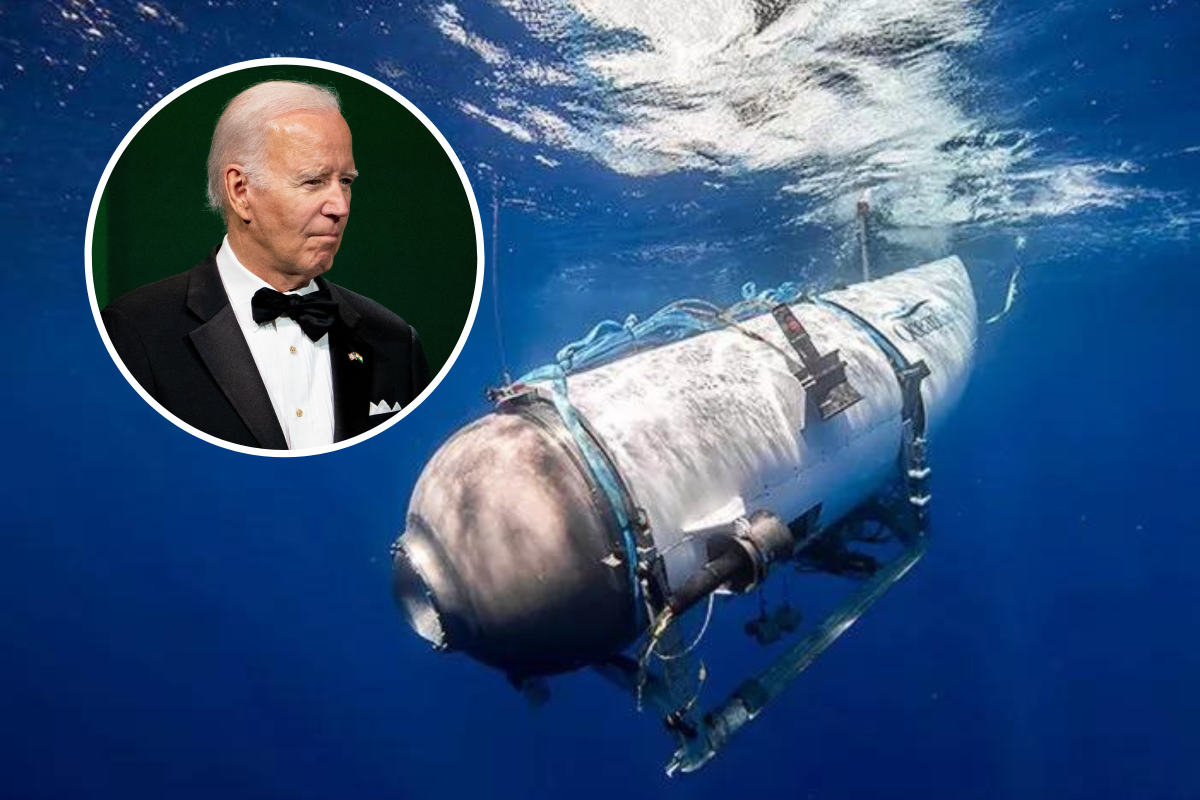
Joe Biden accused of covering up fate of Titanic sub in conspiracy theory
Commentators claimed the president withheld news that the Navy heard Titan exploding so the search operation would distract from stories about Hunter Biden.
 www.newsweek.com

Blunderbuss Firozabad
Made of Pumpkin pie
No, I covered up the fate of the Titan so you would be distracted from my dirty dishes.Joe Biden Accused of Covering Up Fate of Titanic Sub in Conspiracy Theory
Joe Biden accused of covering up fate of Titanic sub in conspiracy theory
Commentators claimed the president withheld news that the Navy heard Titan exploding so the search operation would distract from stories about Hunter Biden.
Side note: Go Navy!
Side-side note to @Satanica: Stevie Nicks. She's not dancing away, she's coming.

CancerMan
Well-Known Member
It's fucking Bluetooth.Wasn't even a real Playstation controller, but a friggin knockoff!
No expense spared.
--------------
@Crazy Cat Lady
Banging heard?
Now is not the time fellas.

Being a mobile phone user for 20 years, if there's one thing that never changes - BLUETOOTH IS FUCKING TRASH AND DOESN'T WORK
That's a masterpiece
Ina few years some new rich person will pay to see the wreckage of this sub and the cycle will continue
Turd Fergusen
Veteran Member
I mean, just compare these two. Alvin has been operating for 59 years!
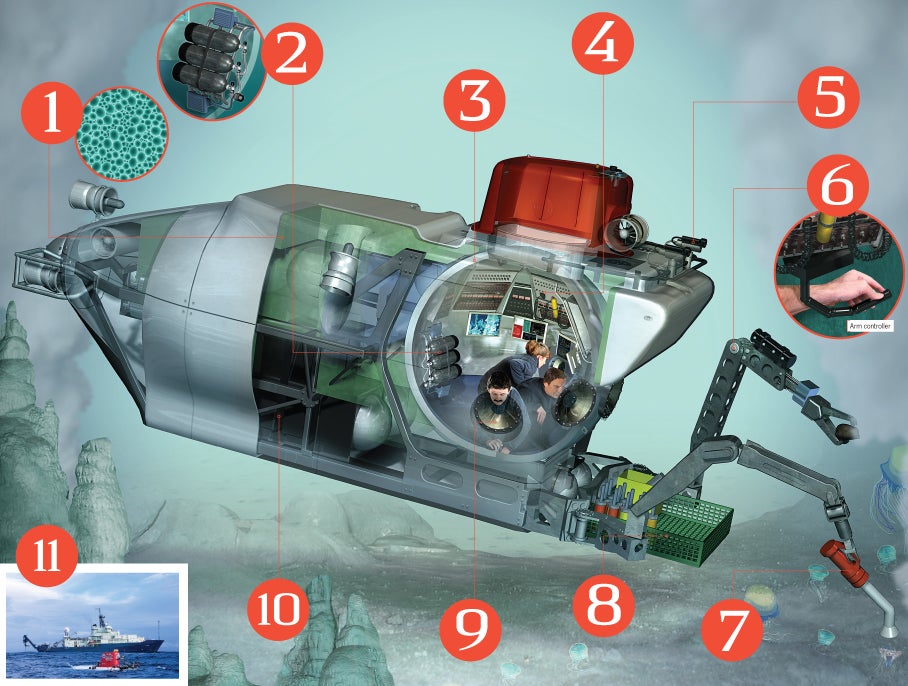


knockout
The Californian
Interesting they would use carbon fiber for these extreme underwater pressures, that Boeing wouldn't use for planes

 www.insider.com
OceanGate CEO once said Titan sub's hull was made with carbon fiber from Boeing that was past its airplane shelf life, would-be passenger says
A writer who said he was set to travel on the doomed Titan submersible said OceanGate CEO Stockton Rush told him that for the vessel's hull, the company used cut-price Boeing carbon fiber that was past its airplane shelf life.OceanGate CEO once said Titan sub's hull was made with carbon fiber from Boeing that was past its airplane shelf life, would-be passenger says
Arnie Weissmann said OceanGate CEO Stockton Rush told him he sourced the Titan's carbon fiber, which was too old "for use in airplanes," from Boeing.
www.insider.com

DamagedGoods
Asmodeus - Destroyer of Men
I have nightmares about getting into iffy looking elevators. I would sooner shoot myself than get into something like the Titan sub, and for once I am not exaggerating. You would have to threaten the life of someone I love to ever get me into that thing.
And these people paid $250 thousand each to do it. And for what? To take turns looking out a smallish porthole in a cramped tube with 4 other people.
And these people paid $250 thousand each to do it. And for what? To take turns looking out a smallish porthole in a cramped tube with 4 other people.
Last edited:

Don't forget you would have to stand/bend over the toilet to look out the window.And these people paid $250 thousand each to do it. And for what? To take turns looking out a smallish porthole in a cramped tube with 4 other people.
'Human remains’ found as first photos show mangled Titan wreckage recovered from sea floor
“Presumed human remains” have been discovered near the wreck of the Titan submarine, the US Coast Guard announced on Wednesday.The remains will be brought back to the US and analyzed, part of the wider international investigation into what went wrong during the catastrophic voyage to the Titanic shipwreck earlier this month.
The announcement comes as the first photos have emerged of the mangled submersible wreckage being recovered from the depths of the Atlantic Ocean.
The dramatic images capture crews unloading pieces of the doomed sub off the Horizon Arctic ship onto dry land at the Canadian Coast Guard pier in St John’s, Newfoundland, on Wednesday – more than one week after it imploded around 13,000 feet underwater close to the wreckage of the Titanic, killing all five men on board.
Dale Molé, a former director of the US Navy for undersea medicine and radiation health, said they would have died instantly and painlessly by the force under the depth of the sea.
“It would have been so sudden, that they wouldn’t even have known that there was a problem, or what happened to them,”
“It’s like being here one minute, and then the switch is turned off. You’re alive one millisecond, and the next millisecond you’re dead,” he said.
... article in full
Titanic sub update: ‘Human remains’ found as first photos show mangled Titan wreckage recovered from sea floor
Investigators from the US Coast Guard, Canada, France and the United Kingdom are working closely together on probe into implosion
 www.aol.com
Turd Fergusen
Veteran Member
I'm 99.9% sure this is the front of the sub, minus the window. I don't see what else it possibly could be.

By no means am I any type of expert but it would seem the central section that held the people just "popped". They've acknowledged they found the rear section, the sled, and this photo would seem to prove the carbon fiber central cylinder is the only thing that is missing.
By no means am I any type of expert but it would seem the central section that held the people just "popped". They've acknowledged they found the rear section, the sled, and this photo would seem to prove the carbon fiber central cylinder is the only thing that is missing.
Hermy
Trusted Member
Under the circumstances, this is the best anyone, especially their loved ones, could hope for.Dale Molé, a former director of the US Navy for undersea medicine and radiation health, said they would have died instantly and painlessly by the force under the depth of the sea.

Apparently they found remains, but it's hard to say what. I didn't expect them to find much more than fragments of the sub.
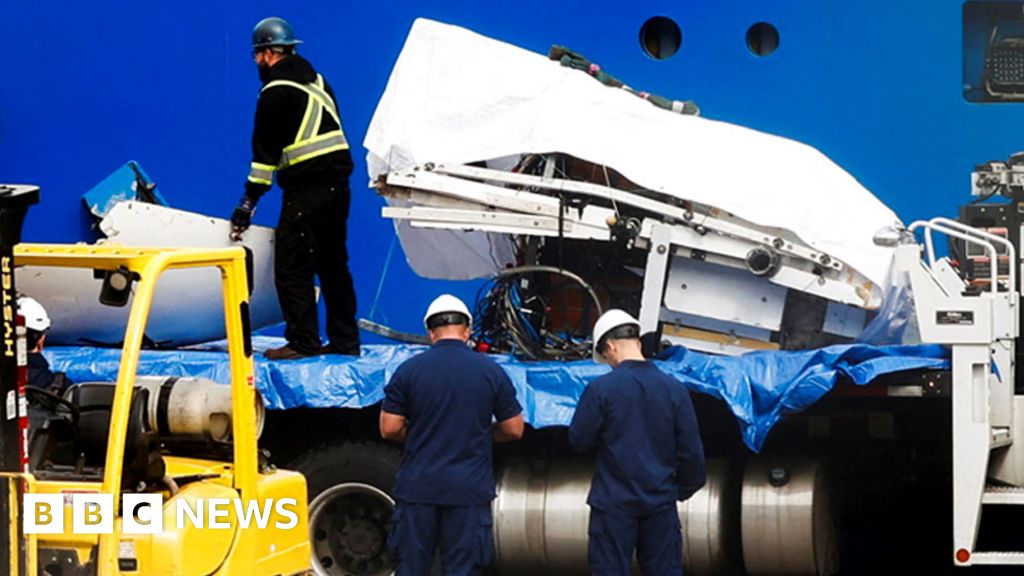
 www.bbc.com
Presumed human remains found in Titan sub debris
Medical experts will analyse the presumed remains, the US Coast Guard said.
www.bbc.com
Last edited:
Hermy
Trusted Member
Their goal of seeing the remains of the Titanic must have been their only thought, to the exclusion of anything else.I can’t imagine the willing passengers did any research into this thing before handing over themselves to this fraudster.


Turd Fergusen
Veteran Member
I have to wonder if they knew. Like was there one sudden crack on the window and they're like "oh, shit" and it happened, or if it was like the end of the Sopranos.
Last edited:
I hope they never had a clue. I pictured them fighting over oxygen tanks, that wasn't a pretty picture either.I have to wonder if they knew. Like was there one sudden crack on the window and there like "oh, shit" and it happened, or if it was like the end of the Sopranos.
Police launch criminal probe into Titan submarine deaths
Canadian police are considering if ‘criminal, federal, or provincial laws’ were broken in the lead up to the Titanic sub sinking. The Royal Canadian Mounted Police will examine the circumstances that lead to the deaths of the five crew on board the sub and decide 'whether or not a full investigation is warranted.'
First off you had the owner Rush and four paying passengers on board who were not crew and I don't really care who the fuck does it, a full investigation is absolutely warranted.
Turd Fergusen
Veteran Member
From everything I've read, and I could be wrong, I think the PH guy was not a paying passenger but was invited along as an expert on the Titanic.First off you had the owner Rush and four paying passengers on board who were not crew and I don't really care who the fuck does it, a full investigation is absolutely warranted.
Titan Sank For 48 Seconds Before Imploding, Expert Paints Grim Picture
The catastrophic event surrounding OceanGate's "Titan" which unfolded in mid-June has been reported on in depth. A recently issued report may detail what passengers felt in the final seconds before the submersible's implosion.
What Happened: The U.S. Navy detected an anomaly consistent with an implosion or explosion near the Titan’s location around the time communication was lost on Sunday, June 18, leading experts to fear the worst.
This is where the analysis by Jose Luis Martin, who has a Ph.D. in electrical engineering from the University of the Basque Country in Spain and is an expert in submarines, comes into play.
The five crew members, including the late OceanGate CEO Stockton Rush, were likely aware of their dire situation in the 48 seconds preceding the implosion of the Titan, according to Martín.
Martín’s study used parameters including the submersible’s weight, thrust, speed, mass, acceleration and the coefficient of friction of water against a falling body to calculate the submersible’s descent.
Martín speculates that since the Titan submersible lost communication with its support vessel at 11:15 a.m., and the electrical went out, it nose-dived for between 48 seconds and 1 minute and 11 seconds before imploding.
During this time, the crew members would have lost their balance and possibly fallen over each other. The sudden loss of propulsion likely caused the 400 kilograms (881.84 pounds) of passengers in the front of the submersible to destabilize the vehicle, forcing it to descend “like an arrow.”
Martín’s report also highlighted the importance of stability in the design of tourist passenger submarines. A well-designed submersible must have a center of gravity located within the “underwater hull” for the vessel to remain stable.
A sudden electrical failure could have disrupted that balance in the Titan, causing it to plunge uncontrollably into the ocean depths.
As the Titan descended, the pressure-resistant hull of the submersible experienced a sudden increase in pressure. The hull contraction was not followed by the material of the porthole, which had different properties.
Martín said that lack of uniform deformation led to a micro-fissure, allowing water to enter at a pressure that led to an immediate implosion.

Latest posts
-
 I Will Not Pray For Oscar Franklin Smith, May He Rot In Hell
- Latest: Sugar Cookie

